This site uses cookies to improve your experience. Learn about our Privacy Policy.

Residency and Foreign Affairs Dubai: Complete GDRFA Guide 2026

Residency and Foreign Affairs Dubai: Complete GDRFA Guide 2026

Residency and Foreign Affairs Dubai refers to GDRFA Dubai (General Directorate of Residency and Foreigners Affairs) — the official UAE government authority that manages all residency visas, entry permits, family sponsorship, and immigration services in Dubai. This guide covers every major aspect of Dubai residency in one place, updated for 2026.

What Is GDRFA Dubai?

GDRFA Dubai — officially the General Directorate of Residency and Foreigners Affairs — is the primary government authority responsible for immigration and residency services across the Emirate of Dubai. Operating under the UAE Federal Authority for Identity, Citizenship, Customs and Port Security (ICP), GDRFA Dubai serves residents, employers, and families navigating Dubai's immigration system.

The term "Residency and Foreign Affairs Dubai" is widely used in search queries to locate GDRFA services, Amer service centres, visa status tools, and application portals. Throughout this guide, both terms are used interchangeably.

What Does GDRFA Dubai Handle?

GDRFA Dubai oversees the full lifecycle of legal residency — from first-time entry permits to long-term residency renewals. Core services include:

  • Entry permits — for new employees, family members, and investors arriving in Dubai
  • Residence visa issuance and renewal — for all categories
  • Family sponsorship processing — allowing eligible residents to sponsor spouse, children, and parents
  • Visa validity and overstay checks — via smart service portals
  • Sponsor file registration — required before family visa applications
  • Immigration smart services — available 24/7 through Amer and GDRFA digital channels
  • Unified number records — tracking all residency data under one identifier

GDRFA becomes directly relevant at three key life stages: when starting employment in Dubai, when sponsoring family members, and when renewing or changing residency status.

Who Is This Guide For?

This guide is written for anyone who needs to understand Dubai's residency system — whether researching for the first time or navigating a specific process. It is particularly useful for:

  • Professionals relocating to Dubai under an employment visa
  • Residents sponsoring a spouse, children, or parents
  • New parents processing a newborn baby visa in Dubai
  • Freelancers and skilled professionals considering the Green Visa
  • Investors and entrepreneurs exploring the Golden Visa route
  • Anyone searching for GDRFA services, Amer centres, or MOFA attestation

Main Dubai Residence Visa Routes

Dubai's residency framework covers several distinct visa categories. Choosing the correct route from the outset avoids delays, rejected applications, and unnecessary cost. The six primary residence routes are:

Visa Type Summary
Work Residence Visa Employer-sponsored; applies to all employment categories
Family Residence Visa Allows residents to sponsor spouse, children, and parents
Student Residence Visa For students enrolled in UAE-approved institutions
Golden Visa Long-term (10 year) residency for investors and skilled professionals
Green Visa Self-sponsored residency for freelancers and qualified employees
Retirement / Virtual Work For retirees meeting financial thresholds or remote workers

1. Work Residence Visa

The work residence visa is the most common residency route in Dubai. The employer acts as sponsor and manages the application through GDRFA or Amer. Most professional employment visa processes also require academic document attestation for licensing, regulatory approval, or qualification verification — a step that is frequently overlooked and causes delays.

Related guide: Degree Certificate Attestation in the UAE

2. Family Residence Visa

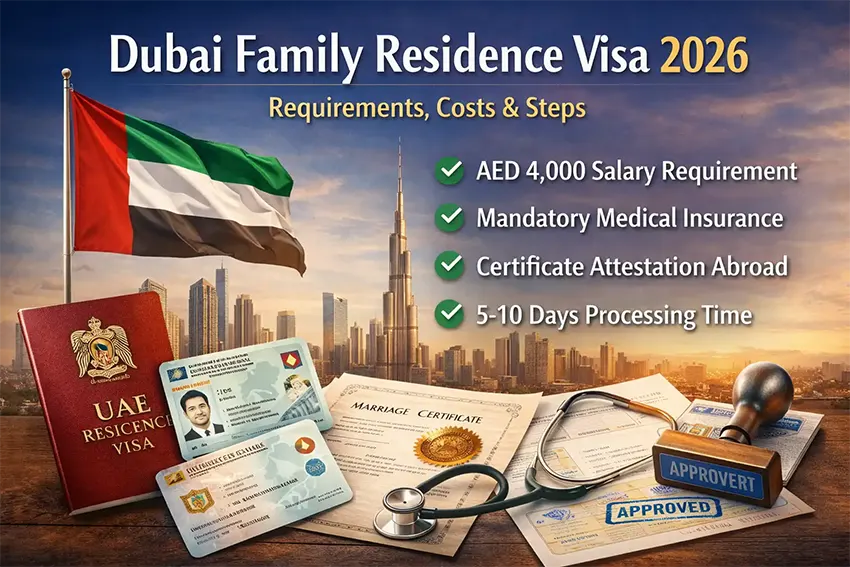
Eligible UAE residents can sponsor immediate family members under the family residence visa. The process is managed through GDRFA Dubai and requires proof of financial eligibility, valid residency, and attested supporting documents.

Minimum eligibility requirements:

  • Minimum monthly salary: AED 4,000 (or AED 3,000 with employer-provided accommodation)
  • Valid UAE residence visa held by the sponsor
  • Medical fitness test for dependants aged 18 and above
  • Attested marriage certificate for spouse sponsorship
  • Attested birth certificate for child sponsorship

Related guide: UAE Family Visa Process

3. Student Residence Visa

Students enrolled in accredited UAE educational institutions can apply for a student residence visa. The institution typically acts as sponsor and processes the application in coordination with GDRFA Dubai. Validity is usually tied to the duration of the academic programme.

4. Golden Visa (Long-Term Residency)

The UAE Golden Visa is a long-term residence visa valid for ten years, renewable upon meeting ongoing eligibility criteria. It is available to investors, entrepreneurs, scientists, outstanding students, and specialised professionals. Unlike standard visas, the Golden Visa does not require employer sponsorship and is not tied to any single employer or institution.

5. Green Visa (Self-Sponsored Residency)

Introduced as part of UAE 2031 vision reforms, the Green Visa allows skilled employees and freelancers to reside in Dubai under self-sponsorship — without needing an employer or family sponsor. Applicants must meet minimum income or professional qualification thresholds set by the relevant authority.

6. Retirement and Virtual Work Residence Visa

Retirees aged 55 and above who meet specific financial eligibility criteria (property ownership, savings threshold, or pension income) may apply for a retirement visa. The virtual work residence visa is available to remote employees working for companies outside the UAE, enabling them to live legally in Dubai while employed abroad.

Family Sponsorship Through GDRFA Dubai

Family sponsorship is one of the most frequently used services offered through GDRFA Dubai. A UAE resident holding a valid residence visa can sponsor qualifying family members, provided the financial and documentation requirements are met.

Who Can Be Sponsored?

  • Spouse (husband or wife) — requires attested marriage certificate
  • Children (sons and daughters up to a qualifying age) — requires attested birth certificate
  • Newborn babies — visa must be processed within 120 days of birth
  • Parents — sponsorship is possible but subject to additional conditions and approvals

Eligibility Requirements for Sponsors

Before initiating a family sponsorship application, the sponsor must ensure the following conditions are satisfied:

  • Monthly income of AED 4,000 or more (AED 3,000 if accommodation is employer-provided)
  • A valid UAE residence visa that is not due to expire within six months
  • A sponsor file registered with GDRFA Dubai (mandatory for new sponsorships)
  • Valid Ejari (tenancy registration) or proof of accommodation

Required Documents for Family Sponsorship

Document Notes
Sponsor's Passport Clear copy of all pages
Sponsor's Emirates ID Front and back copy
Dependent's Passport Clear copy of all pages
Salary Certificate Issued by employer, on company letterhead
Ejari / Housing Proof Registered tenancy contract or equivalent
Marriage Certificate Legally attested — required for spouse
Birth Certificate Legally attested — required for each child
Photographs Recent passport-size, white background
Medical Fitness Certificate Required for dependants aged 18 and above

Document Attestation and GDRFA Requirements

Document attestation is a mandatory legal process that verifies the authenticity of foreign-issued certificates before they are accepted by UAE government authorities, including GDRFA Dubai. Unattested documents are rejected at the application stage, causing delays and additional costs.

GDRFA's requirements are clear: marriage and birth certificates used in family sponsorship applications must be legally attested before submission. The same applies to academic certificates used in employment visa and professional licensing applications.

Common Attestation Requirements

Attestation Type When Required
Marriage Certificate Attestation Required for spouse sponsorship applications
Birth Certificate Attestation Required for child and newborn visa processing
Degree Certificate Attestation Required for employment visas and professional licensing
MOFA Attestation Final attestation step — Ministry of Foreign Affairs, Dubai
Legal Translation Required for documents not in Arabic or English

Related guide: MOFA Attestation in Dubai

Why Degree Attestation Matters for Employment Visas

For employment-based residence visas, academic qualification documents frequently require legalization before GDRFA and relevant licensing authorities will process the application. This applies to university degrees, diplomas, and professional certificates issued outside the UAE.

The three scenarios where degree attestation is most commonly required:

  • Job approvals requiring proof of academic qualification
  • Professional licensing (healthcare, engineering, legal, education sectors)
  • Government processing of employment visa documentation

Applications submitted without correctly attested documents are subject to rejection or indefinite delay at the GDRFA processing stage.

Newborn Baby Visa in Dubai: What Parents Must Know

Parents of a child born in Dubai must complete visa formalities within 120 days of the child's birth. Missing this window results in overstay fines and complications with the child's legal status in the UAE.

Key Steps for Newborn Visa Processing

  1. Obtain the birth certificate from the hospital or relevant civil registry
  2. Complete birth certificate attestation through the appropriate authority
  3. Apply for the newborn's passport through the relevant embassy or consulate
  4. Register the child's Emirates ID
  5. Submit the residence visa application through GDRFA Dubai or Amer

The most common cause of delay in newborn visa processing is deferred document preparation. Attestation of the birth certificate must be completed before the visa application can be submitted. Parents are strongly advised to begin this process within the first few weeks after birth.

How the Dubai Residency Process Works: Step by Step

Regardless of visa category, the Dubai residency application process follows a consistent sequence of steps. Completing each step correctly before proceeding to the next significantly reduces processing time.

Step 1 — Identify the Correct Visa Type
Confirm whether the case qualifies as a work, family, student, or long-term residency application. Applying under the wrong category results in rejection and reprocessing costs.

Step 2 — Prepare and Attest All Documents
Compile passports, photographs, sponsor documents, salary certificates, housing proof, and all certificates requiring attestation. Attestation should be initiated early as it can take several weeks.

Step 3 — Register a Sponsor File (if required)
For family sponsorship applications, the sponsor must register an active sponsor file with GDRFA Dubai before proceeding.

Step 4 — Submit the Application via GDRFA or Amer
Applications can be submitted through GDRFA's smart service portal, via Amer service centres, or through authorised typing centres. Status can be tracked digitally throughout the process.

Step 5 — Complete Medical Fitness Test
Applicants aged 18 and above must complete a medical fitness examination at an approved UAE health centre before the residence visa is issued.

Step 6 — Emirates ID Registration
All residence visa holders must register for an Emirates ID. The ID serves as the primary identification document in the UAE.

Step 7 — Visa Stamping and Confirmation
Once approved, the residence visa is stamped in the passport. Applicants can track and confirm the status through GDRFA's online portal or Amer service channels.

GDRFA Fees and Processing Timelines

Fees for GDRFA Dubai services vary depending on visa type, processing speed, and case complexity. The table below outlines the primary fee categories for reference. For exact, current figures, always verify directly with GDRFA or Amer service centres, as fees are subject to change.

Service Fee Notes
Sponsor File Registration One-time fee; required before family sponsorship
Entry Permit Issuance Applied per applicant; varies by category
Residence Visa Stamping Per applicant; standard and urgent options
Medical Fitness Test Paid at approved health centres
Emirates ID Registration Per applicant; included in residency package
Visa Renewal Due before expiry; varies by visa type and duration

Official Source: All fee information should be verified at gdrfad.gov.ae or through any authorised Amer service centre in Dubai.

GDRFA vs Amer vs MOFA: Understanding the Difference

Three authorities are most commonly referenced in the Dubai residency process. Understanding the role of each prevents confusion about which body handles a specific requirement:

Authority Role in the Residency Process
GDRFA Dubai The primary immigration authority. Approves, issues, and manages all residence visas and entry permits in Dubai. Final decision-making authority on all residency matters.
Amer Service Centres Authorised service channels that assist individuals and employers with the submission and processing of GDRFA applications. Not a separate authority — operates under GDRFA.
MOFA (Ministry of Foreign Affairs) Responsible for the final stage of document attestation — legalising foreign-issued certificates for use in the UAE. Separate from GDRFA but a prerequisite for many visa applications.

Common Reasons Dubai Residency Applications Are Delayed

The majority of application delays are avoidable. The following are the most frequently cited reasons applications stall or are returned at the GDRFA processing stage:

  • Unattested marriage certificate — One of the most common reasons for family visa rejection
  • Missing birth certificate attestation — Required for child and newborn visa processing without exception
  • Incomplete salary or employment documents — Salary certificate must be on official letterhead and recently dated
  • Missing or expired Ejari — Housing proof must be valid and registered through Ejari portal
  • Incorrect visa category selected — Applicants selecting the wrong category face reprocessing from start
  • Pending medical fitness test — Medical clearance must precede final visa stamping for adults
  • Expired sponsor residence visa — Sponsor's own visa must be valid and not due to expire imminently

Official GDRFA Dubai Contact Information

Channel Details
Phone (within UAE) 800 5111
International +971 4 313 9999
Email amer@gdrfad.gov.ae
Live Chat Available via Amer smart service portal
Head Office Location Al Jafiliya, Dubai, UAE
Official Website gdrfad.gov.ae
Smart App GDRFA Dubai app — available on iOS and Android

Authority Note: GDRFA Dubai operates under the UAE Federal Authority for Identity, Citizenship, Customs and Port Security (ICP). Always use official channels to verify visa status and application updates.

Frequently Asked Questions

The following questions represent the most commonly searched queries related to Residency and Foreign Affairs Dubai and GDRFA services.

What is Residency and Foreign Affairs Dubai?

"Residency and Foreign Affairs Dubai" is the widely used search term for GDRFA Dubai — the General Directorate of Residency and Foreigners Affairs — which is the official UAE government authority responsible for all immigration and residency services in the Emirate of Dubai.

Is GDRFA Dubai the same as the immigration authority?

Yes. GDRFA Dubai is Dubai's primary immigration authority. It manages entry permits, residence visas, family sponsorship, and overstay checks, operating under the UAE's federal immigration framework.

Can UAE residents sponsor family members?

Yes. UAE residents meeting the minimum salary threshold (AED 4,000 per month, or AED 3,000 with employer accommodation) and holding a valid residence visa can sponsor their spouse, children, and — under additional conditions — their parents.

Do family sponsorship documents need to be attested?

Yes. Marriage certificates must be legally attested for spouse sponsorship. Birth certificates must be attested for child sponsorship. Unattested documents are rejected by GDRFA at the application stage.

How long do parents have to process a newborn visa in Dubai?

Parents have 120 days from the date of birth to complete the visa formalities for a newborn in Dubai. After this window, overstay penalties apply.

What is the difference between GDRFA and Amer?

GDRFA Dubai is the immigration authority that approves and issues residence visas. Amer is an authorised service channel that assists individuals and employers with submitting and tracking applications through GDRFA — it is not a separate authority.

What is MOFA attestation and when is it needed?

MOFA attestation refers to the Ministry of Foreign Affairs' legalisation of foreign-issued documents for use in the UAE. It is typically required as the final attestation step for marriage certificates, birth certificates, and degree certificates used in residency and visa applications.

What are the main residence visa types in Dubai?

The primary residence visa categories in Dubai are: Work Residence Visa, Family Residence Visa, Student Residence Visa, Golden Visa (long-term), Green Visa (self-sponsored), and Retirement / Virtual Work Residence Visa.

How do I contact GDRFA Dubai?

GDRFA Dubai can be contacted by phone at 800 5111 (within the UAE) or +971 4 313 9999 (international), by email at amer@gdrfad.gov.ae, through the Amer live chat portal, or in person at the Al Jafiliya office in Dubai.

How do I check my visa status with GDRFA?

Visa status can be checked through the GDRFA Dubai smart services portal at gdrfad.gov.ae, via the GDRFA Dubai mobile app, or by contacting Amer through official service channels.

Residency and Foreign Affairs Dubai encompasses the complete system of immigration, sponsorship, and legal residency in the emirate. Identifying the correct visa route, preparing documents accurately, and completing attestation requirements ahead of submission are the three most effective steps for improving approval speed and avoiding delays. This guide will continue to be updated as GDRFA policies, fee structures, and visa categories evolve through 2026 and beyond.

This content is provided for informational purposes only. Always verify visa requirements, fees, and procedures through official GDRFA Dubai channels before initiating any immigration process.

Contact Us

Contact Us

============================================================ */